
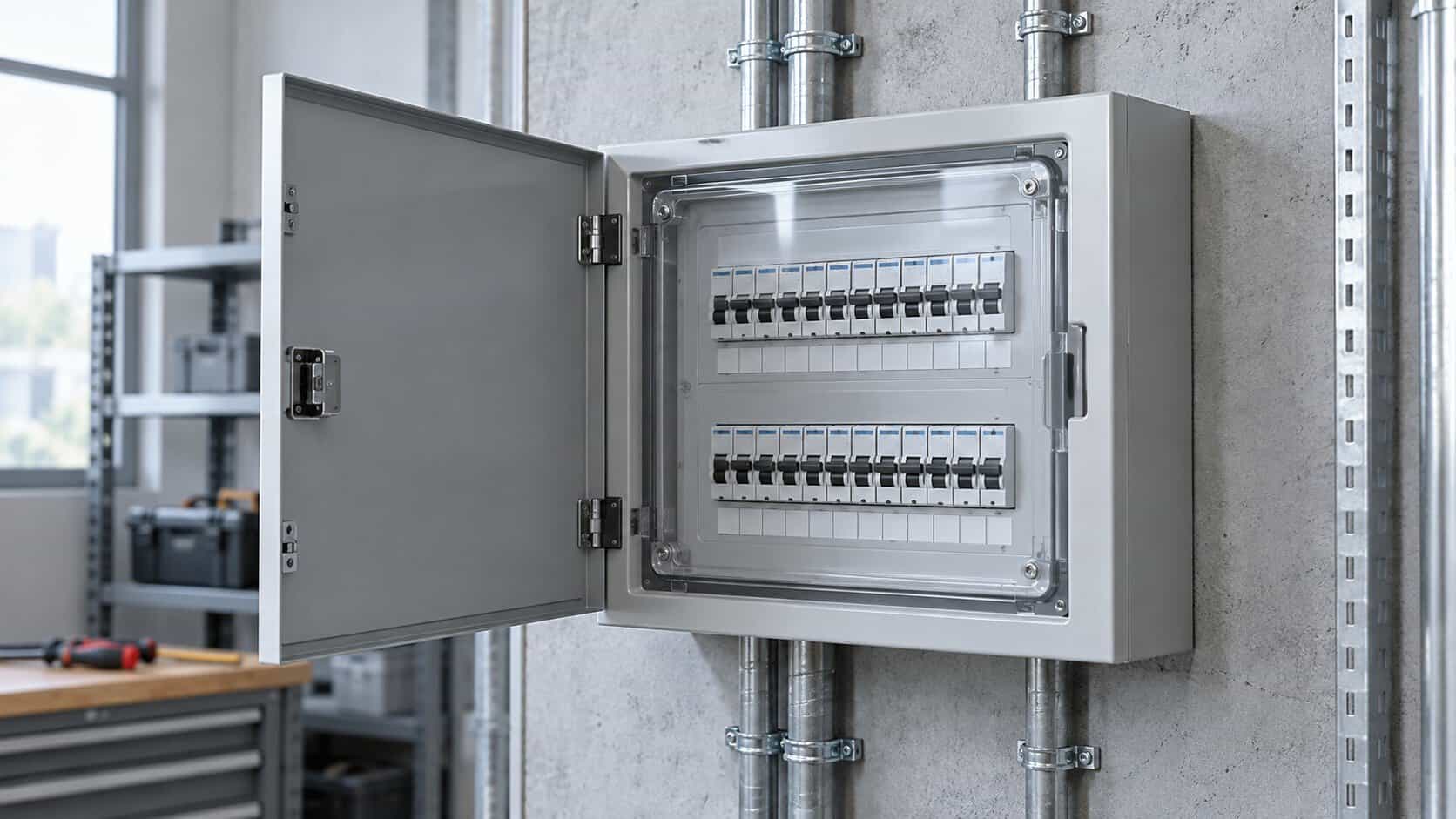
A direct lightning strike can inject hundreds of thousands of amperes into a building or substation in microseconds. A complete lightning protection system captures the strike, conducts it safely to earth, and disperses the energy into the ground. It also coordinates with surge protective devices inside distribution boards and switchgear to protect equipment from indirect surges induced by nearby strikes.
What Is a Lightning Protection System?
A lightning protection system (LPS) is an assembly of air terminals, down conductors, grounding electrodes, and bonding conductors designed to intercept a lightning strike and provide a low-impedance path to earth. The goal is not to prevent lightning but to control where it goes, keeping the current away from people, structure, and sensitive equipment.
External LPS design is governed by IEC 62305 internationally and NFPA 780 in North America. BS EN 62305 is the UK implementation of IEC 62305, and GB 50057 is the Chinese standard for lightning protection of buildings. Surge protective devices inside panels follow IEC 61643 and UL 1449.
How Lightning Protection Works
Lightning is a discharge between charged regions of a cloud and ground. The protection system uses a network of elevated air terminals to create preferred attachment points. When lightning strikes, the current travels down dedicated conductors to grounding electrodes buried in the earth. The grounding system then spreads the charge over a large area, keeping step and touch voltages within safe limits.
Equally important is equipotential bonding. All metallic parts — cable trays, pipes, reinforcement steel, and equipment enclosures — must be bonded to the LPS to prevent side flashes, where current jumps from the down conductor to nearby metalwork.
External vs Internal Lightning Protection
| Aspect | External LPS | Internal LPS / Surge Protection |
|---|---|---|
| Primary function | Intercept direct strike and conduct it to earth | Limit surge voltage inside the building |
| Key components | Air terminals, down conductors, earth electrodes | SPDs, bonding bars, shielded cables |
| Standards | IEC 62305-3, NFPA 780, GB 50057 | IEC 61643, IEC 62305-4, UL 1449 |
| Protection class | I, II, III, IV based on risk level | Type 1, Type 2, Type 3 based on location |
| Failure mode | Physical damage, fire, structural damage | Equipment damage, downtime, data loss |
| Typical inspection | Visual check, continuity, earth resistance | SPD status indicators, leakage current |
Key Components of an External LPS
Air Terminals
Air terminals are the interception points placed at the highest points of a structure. They can be pointed rods, meshed conductors, or natural metal components such as metal roofs or rails. IEC 62305 uses the rolling sphere method or protection angle method to determine placement and spacing.
Down Conductors
Down conductors carry the lightning current from the air terminals to the grounding system. They should be short, straight, and have multiple parallel paths where possible. Sharp bends increase impedance and should be avoided.
Earth Termination Network
The earth termination network disperses current into the soil. Common electrodes include vertical rods, horizontal rings, and foundation earth electrodes. Total earth resistance depends on soil resistivity; lower is better, but IEC 62305 also accepts higher values if equipotential bonding is adequate.
Equipotential Bonding
All incoming services — power, data, pipework — must be bonded to the main earthing terminal at the building entry point. This prevents dangerous potential differences during a strike.
Types of Surge Protective Devices
Type 1 SPD
Installed at the main distribution board where overhead lines enter a building. Type 1 SPDs can discharge the partial lightning current from a direct strike and are often combined with a Type 2 device in a single housing.
Type 2 SPD
Installed at sub-distribution boards to protect downstream equipment from switching surges and the residual energy from a Type 1 device. Type 2 SPDs have lower voltage protection levels and are the standard choice for floor distribution boards.
Type 3 SPD
Point-of-use protectors installed close to sensitive equipment such as servers, PLCs, and instrumentation. They supplement, but do not replace, upstream Type 1 and Type 2 devices.
Typical Applications
Commercial and High-Rise Buildings
Lightning protection is mandatory for tall structures in most jurisdictions. External LPS protects the building envelope, while Type 1 and Type 2 SPDs protect distribution boards, elevators, fire systems, and HVAC controls.
Industrial Plants and Substations
Outdoor switchgear, transformers, and cable trays are vulnerable to direct strikes. Substation LPS uses elevated masts or shield wires, plus robust grounding grids. Internal SPDs protect relays, meters, and control circuits.
Data Centers and Telecommunication Sites
These facilities require very low residual surge levels. A multi-stage SPD network, shielded cable routes, and comprehensive equipotential bonding are standard practice.
How to Design a Lightning Protection System
- Assess risk. IEC 62305-2 provides a risk assessment method that considers building use, height, location, and consequences of damage.
- Select protection class. Class I offers the highest protection and is used for high-risk or explosive environments. Lower classes may be acceptable for ordinary buildings.
- Position air terminals. Use the rolling sphere or protection angle method to ensure all parts of the roof are within the protected volume.
- Size conductors. Copper or aluminum conductors must meet the minimum cross-sectional area for the selected protection class under IEC 62305-3.
- Design the earth network. Aim for low impedance and multiple electrodes; bond to the building’s main earthing system.
- Coordinate SPDs. Install Type 1 at the service entrance, Type 2 at distribution boards, and Type 3 at sensitive equipment. Maintain adequate wiring distance between SPD and the equipment.
- Document and inspect. Keep drawings, test records, and inspection reports for maintenance and insurance purposes.
Quality Inspection and Acceptance Points
- Verify air terminal placement against the approved drawing using the rolling sphere or protection angle method.
- Measure continuity of down conductors from air terminals to earth electrodes.
- Test earth resistance with a fall-of-potential or clamp-on tester; compare against the design value.
- Check that all metallic services are bonded at the main earthing terminal.
- Inspect SPD enclosures for correct type, voltage protection level, and status indicators.
- Confirm surge counters and remote monitoring contacts are wired and functioning where specified.
Supplier Evaluation Checklist
- Does the supplier provide LPS design calculations to IEC 62305 or NFPA 780, including risk assessment and protection class?
- Are conductors and fittings made from corrosion-resistant materials such as copper, aluminum, or stainless steel?
- Can the supplier provide certified SPDs with the correct type, maximum continuous operating voltage, and voltage protection level?
- Is installation supervision and commissioning testing included in the scope?
- Are maintenance manuals and inspection schedules provided after handover?
Frequently Asked Questions
1. Does every building need a lightning protection system?
Not every building, but codes such as IEC 62305, NFPA 780, and GB 50057 require protection for tall, high-occupancy, or high-value structures. A risk assessment determines whether a system is mandatory.
2. Can SPDs replace an external LPS?
No. SPDs protect against induced surges and partial currents from direct strikes but cannot intercept a direct strike to a building. A complete system needs both external LPS and internal SPDs.
3. What is the rolling sphere method?
The rolling sphere method imagines a sphere of a given radius, based on protection class, rolling over the structure. Any surface the sphere touches is unprotected. Air terminals must be placed so the sphere cannot touch the structure.
4. How often should an LPS be inspected?
Visual inspections are typically performed annually, with detailed electrical testing every 11 months or as required by local regulations. After a known lightning strike, an immediate inspection is recommended.
5. What materials are used for conductors?
Copper and aluminum are the most common. Copper offers better conductivity and corrosion resistance but costs more. Aluminum is lighter and widely used for large installations. Both must be sized to the applicable standard.
6. Why is equipotential bonding important?
During a strike, large currents create potential differences between nearby metal objects. Bonding equalizes these potentials and prevents dangerous side flashes that can injure people or ignite materials.
7. Where should SPDs be installed?
Install Type 1 SPDs at the main service entrance, Type 2 SPDs at distribution boards, and Type 3 SPDs at sensitive loads. The closer the SPD is to the equipment, the better the protection.
Protect Your Distribution System with BANGE Electric
BANGE Electric manufactures distribution boxes, switchgear assemblies, and busway systems that accommodate surge protective devices and provide reliable earthing terminals. Whether you need a sub-distribution board with Type 2 SPDs or a main distribution panel with Type 1+2 combined protection, our engineering team can integrate protection into a complete power distribution solution.
Explore our distribution box range or send us your load list for a tailored proposal.
Requirements may vary by application, market, and applicable standard. Final specification should be confirmed with the engineering team.