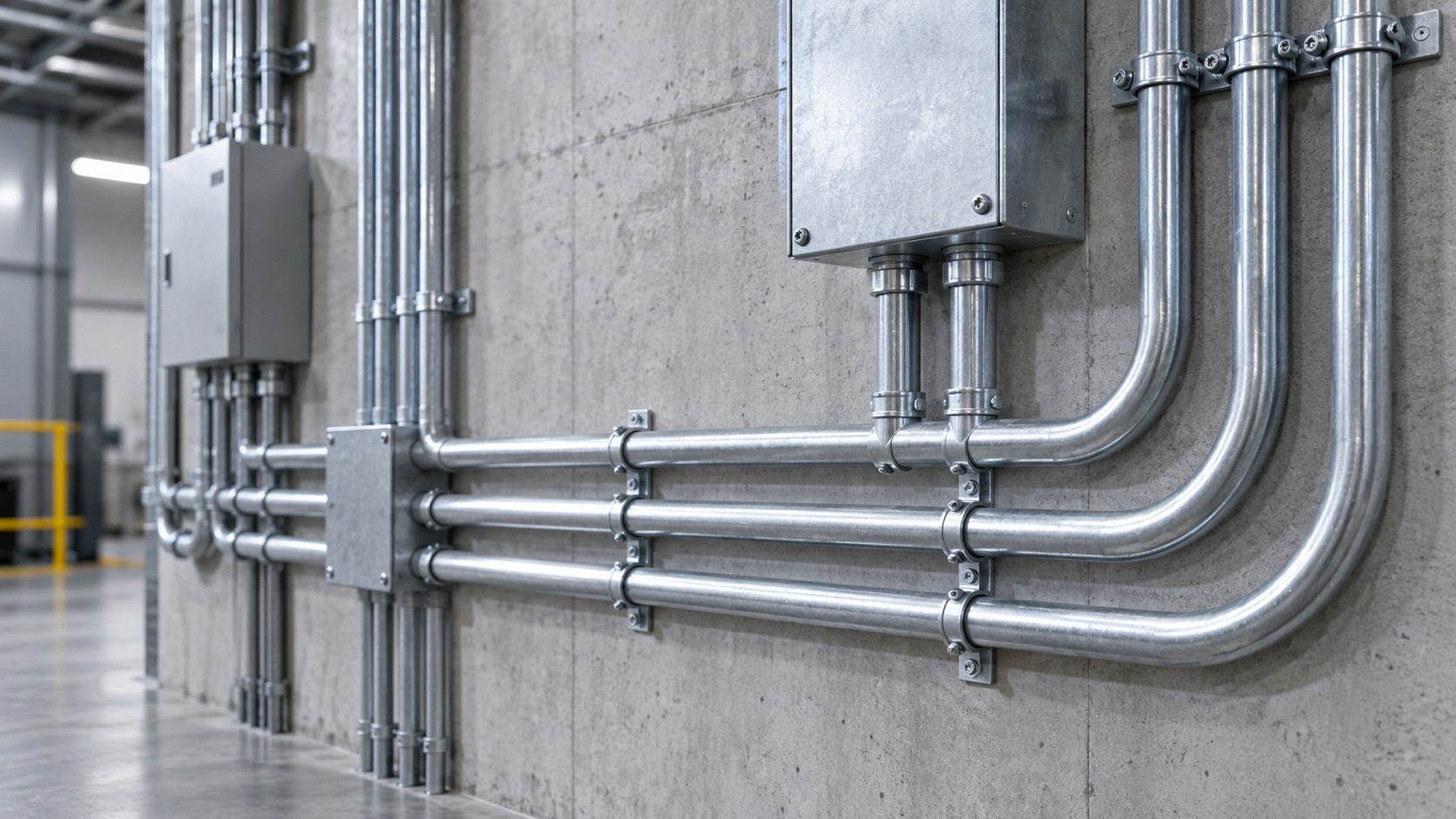
A busway’s IP rating tells you how well the enclosure resists solid objects and water — nothing more. IEC 60529 defines the code, IEC 61439-6 requires the declared degree of protection to be verified, and the practical choice is driven by where the run lives: IP54 for indoor risers, IP65 for weather-exposed runs, IP68 for below-grade or flood-prone routes. The rating is only as good as its weakest point — joints, tap-off openings and terminations.
What the IP Code Does — and Does Not — Cover
IEC 60529 “Degrees of protection provided by enclosures (IP Code)” defines a two-numeral code. The first numeral describes protection against access to hazardous parts and against solid foreign objects; the second describes protection against water. Optional letters follow: an “additional letter” (A, B, C, D) for protection of persons against access to hazardous parts, and a “supplementary letter” (H, M, S, W) for high voltage, motion during the water test, standing still during the water test, or weather conditions.
| First numeral | Protection against solid objects | Second numeral | Protection against water |
|---|---|---|---|
| 0 | No protection | 0 | No protection |
| 1 | ≥ 50 mm diameter | 1 | Vertically dripping water |
| 2 | ≥ 12.5 mm diameter (finger-sized probe) | 2 | Dripping water, enclosure tilted 15° |
| 3 | ≥ 2.5 mm diameter (tools, wires) | 3 | Spraying water (up to 60° from vertical) |
| 4 | ≥ 1.0 mm diameter | 4 | Splashing water from any direction |
| 5 | Dust-protected (ingress not fully prevented, but not harmful) | 5 | Water jets (nozzle 6.3 mm) |
| 6 | Dust-tight | 6 | Powerful water jets (nozzle 12.5 mm) |
| — | — | 7 | Temporary immersion (30 min, 1 m depth as standard condition) |
| — | — | 8 | Continuous immersion — conditions more severe than IPX7, subject to agreement between manufacturer and user |
| — | — | 9 | Powerful high-temperature water jets |
Two points regularly cause trouble in procurement:
- IP69K is not an IEC 60529 rating. It comes from ISO 20653 (road vehicles) / DIN 40050-9. If a project asks for IP69K on a busway, the test method, water temperature, pressure, flow rate and nozzle distance must be written into the specification explicitly.
- IP says nothing about corrosion, UV, impact or gasket life. Corrosion is covered by standards such as ISO 9223 (corrosivity categories C1 to CX) and ISO 12944 (protective paint systems); mechanical impact resistance is covered by IEC 62262 (IK code); coating durability against laboratory light sources is tested per the ISO 16474 series for paints or ISO 4892 for plastics.
In North America, enclosures are commonly classified per NEMA 250 with tests per UL 50E. NEMA Type 3R (rain, sleet, external ice formation), Type 4 (watertight, hose-down), Type 4X (Type 4 plus corrosion resistance) and Type 6P (prolonged immersion) are the usual equivalents discussed. NEMA and IP are not one-to-one conversions — do not accept “4X equals IP66” without the actual test report.
Typical IP Levels for Busway by Location
IEC 61439-6 (busbar trunking systems) requires the degree of protection to be declared by the manufacturer and verified against IEC 60529. In practice, ratings cluster as follows:
| Location | Commonly specified IP | Why | What else matters |
|---|---|---|---|
| Indoor electrical room, dry and supervised | IP41 to IP54 | Limited dust, no water exposure | Ventilation for heat dissipation; permissible temperature rise per IEC 61439-1/-6 |
| Building riser shaft, indoor | IP54 | Construction dust during fit-out, occasional cleaning water | Fire barrier at each floor penetration; support spacing for vertical runs |
| Industrial indoor — dust, oil mist, metal swarf | IP54 to IP55 | Conductive dust and water jets during wash-down | Gasket oil resistance; plug-in outlet covers |
| Outdoor, weather-exposed (rooftop, façade, pipe rack) | IP65, sometimes IP66 | Driving rain and hose cleaning | UV-stable coating, drainage/breather, corrosion category C4 or higher in coastal zones |
| Food, beverage and pharmaceutical wash-down | IP66 to IP69 / IP69K | High-pressure, high-temperature cleaning | Stainless hardware, smooth cleanable surfaces, chemical compatibility of gaskets |
| Underground duct, utility tunnel, flood-prone basement | IP68 | Possibility of prolonged submersion | Stated immersion depth and duration; sealed joints and terminations; external corrosion protection |
Note that raising the IP level reduces heat dissipation. A sealed IP66 or IP68 housing traps heat, so the continuous current rating must be taken from the manufacturer’s data for that specific enclosure type, not from the open-style figure. Where a project needs both a high IP and a high current, expect either a larger cross-section or a documented derating factor.
Where Water Actually Gets In: Joints, Tap-Off Openings and Terminations
The housing extrusion is rarely the failure point. Water enters through the interfaces:
- Housing joints between straight lengths. The joint is a bolted assembly with a gasket or sealing compound. Torque values stated by the manufacturer must be applied with a calibrated tool; under-torque leaves a gap, over-torque extrudes the gasket.
- Plug-in openings. Openings intended for tap-off units must be closed so that the declared degree of protection is maintained when no unit is fitted. An uncovered plug-in opening turns an IP65 run into an unprotected one.
- Tap-off boxes themselves. A busway rated IP65 with tap-off boxes rated IP54 is an IP54 installation at every tap point. The rating of every connected accessory must be checked individually.
- End feed and termination boxes. The transition to cable is a classic weak point. Cable glands must match the cable diameter and the enclosure rating; unused entries must be blanked.
- Drainage provisions. A plain open drain hole defeats the rating. Where condensation control is needed, specify a purpose-made drain/breather device with a stated IP rating and a hydrophobic membrane, and include it in the maintenance schedule.
Gasket material selection should be stated in the purchase specification: EPDM for general weather sealing, silicone for a wider temperature range, nitrile or neoprene where oils are present. Ask for the compression-set figure and the service temperature range, because a gasket that has taken a permanent set will not re-seal after the joint is opened for maintenance.
Application Scenario / Case Analysis: Rooftop Run Feeding a Below-Grade Utility Corridor
Scenario constraints
A mixed route: 80 m of busway on an exposed rooftop, then a vertical drop into a below-grade utility corridor that carries storm water and has flooded twice in the last decade. Ambient temperature swings from −5 °C to +45 °C across the year, and the rooftop surface temperature in summer is significantly higher than the air temperature. The corridor section must remain operational after short-term submersion, and maintenance access is limited to a two-hour window per month.
Selection approach
- Split the specification: IP65 minimum for the rooftop section, IP68 for the corridor section, with the immersion condition stated explicitly (for example, 1 m of water head for 72 hours — to be agreed and recorded, because IPX8 conditions are defined by agreement, not by a fixed default).
- Specify a UV-stable coating system and check the corrosivity category. If the site is coastal or near a de-icing salt route, work to ISO 9223 category C4/C5 and consider stainless fasteners; ISO 1461 hot-dip galvanizing is a common baseline but is not automatically adequate in C5.
- Select tap-off boxes, end feeds and blanking covers at the same IP level as the section they serve, and require the manufacturer to confirm the assembled rating in writing.
- Because the corridor section is sealed, take the continuous current rating from the sealed-enclosure data and verify the temperature rise is within the limits given in IEC 61439-1 for busbars and connections and for accessible surfaces.
- Provide drainage/breather devices at the low points, and locate them where they can be inspected.
Common mistakes
- Specifying IP68 for the trunking but leaving tap-off boxes and termination boxes at IP54.
- Sealing the system completely and then discovering internal condensation — the cure is a rated breather/drain, not an open hole.
- Ignoring galvanic corrosion: aluminium housings bolted directly to stainless steel supports or copper bonding straps will corrode without isolation.
- Reusing gaskets after a joint has been opened for modification; gasket compression set is not recoverable.
- Assuming a high IP rating also means the enclosure survives impact — specify the IK code per IEC 62262 separately where mechanical damage is likely.
Acceptance checkpoints
- Obtain the IEC 60529 test report for the declared rating from an accredited laboratory, and check that the report covers the actual product family and size, not a different range.
- Confirm the agreed immersion parameters are written into the report for IPX8 claims.
- Record joint torque values, gasket part numbers and installation date for every joint.
- Verify coating thickness on site with the appropriate gauge method, and record the measured values.
- Carry out the dielectric verification and insulation resistance measurement required by IEC 61439-6, and record results before energisation and after any flooding event.
Selection Key Points
- Start from the environment, not from a default rating: indoor dry, indoor wet/dusty, outdoor weather-exposed, wash-down, or submersible.
- State the IP level for every component in the run — trunking, joints, tap-off boxes, end feeds, covers, breathers.
- Cross-check the sealed-enclosure current rating; a higher IP can lower the continuous ampacity.
- Pair the IP requirement with a corrosion category (ISO 9223) and a coating specification, plus an IK rating where impact is possible.
- Require the test report, not just a datasheet claim, and check the report’s scope covers the ordered configuration.
Quality Inspection Points
- Coating or surface finish check against the specified system; no bare metal at cut edges or drilled holes.
- Torque verification on joints using a calibrated torque tool against the manufacturer’s stated value.
- Coating thickness measurement and adhesion check on a sample basis.
- Degree-of-protection type-test evidence per IEC 60529 for the declared rating.
- Dielectric test and insulation resistance measurement per IEC 61439-6 before handover.
Supplier Evaluation
Ask the manufacturer to provide, in writing: the IEC 60529 test reports for each rating they claim, the IEC 61439-6 type-test or design-verification documentation, the gasket material data sheet including compression set and temperature range, the coating specification with the applicable ISO 12944 or equivalent system, and the sealed-enclosure current rating tables. Ask how they handle mixed routes, since that is where warranty claims usually originate. A supplier that can only quote a single rating for an entire project is a warning sign.
BANGE Electric supplies busway systems for indoor riser, outdoor and below-grade routes, and can provide the rating documentation for each section of a mixed installation. See the busway systems range, or contact the engineering team for a route-by-rating review.
FAQ
1. Is IP65 always better than IP54 for busway?
Not automatically. IP65 keeps out water jets, but a sealed housing dissipates heat less effectively, so the continuous current rating may be lower. Choose the lowest rating that satisfies the environment, then check the ampacity for that enclosure type.
2. What is the difference between IP67 and IP68?
IP67 is a defined short-duration immersion test (typically 30 minutes at 1 m depth). IP68 is continuous immersion under conditions that are more severe than IP67 and must be agreed between manufacturer and user — so an IP68 claim without stated depth and duration is meaningless.
3. Does IP68 mean the busway can be buried directly in soil?
No. IP68 addresses water ingress into the enclosure only. Burial also requires external corrosion protection, mechanical protection, consideration of soil corrosivity, and sealed joints and terminations. These must be specified separately.
4. Is IP69K covered by IEC 60529?
No — IP69K comes from ISO 20653 (formerly DIN 40050-9). IEC 60529 includes second numeral 9 for powerful high-temperature water jets, but the test parameters differ, so always state which standard applies.
5. Do tap-off boxes need the same IP rating as the trunking?
Yes. The achieved rating of the installation is the lowest rating of any component in the run. Confirm the rating of each tap-off box, plug-in cover and end feed box individually.
6. How do I prevent condensation inside a sealed busway?
Eliminate water entry paths, then provide a rated drain/breather device at low points rather than an open drain hole. Include those devices in the periodic inspection schedule, because a blocked membrane stops working silently.
7. Does a high IP rating protect against corrosion?
No. Corrosion resistance is addressed separately — ISO 9223 for corrosivity categories, ISO 12944 for protective paint systems, ISO 1461 for hot-dip galvanizing. A coastal site needs both a high IP and a suitable corrosion protection system.
Talk to BANGE About Your Busway Specification
Send your route description, current rating, ambient conditions and required IP level, and we will return a section-by-section proposal with the supporting rating documentation. Contact BANGE Electric to start the review.
Requirements may vary by application, market, and applicable standard.