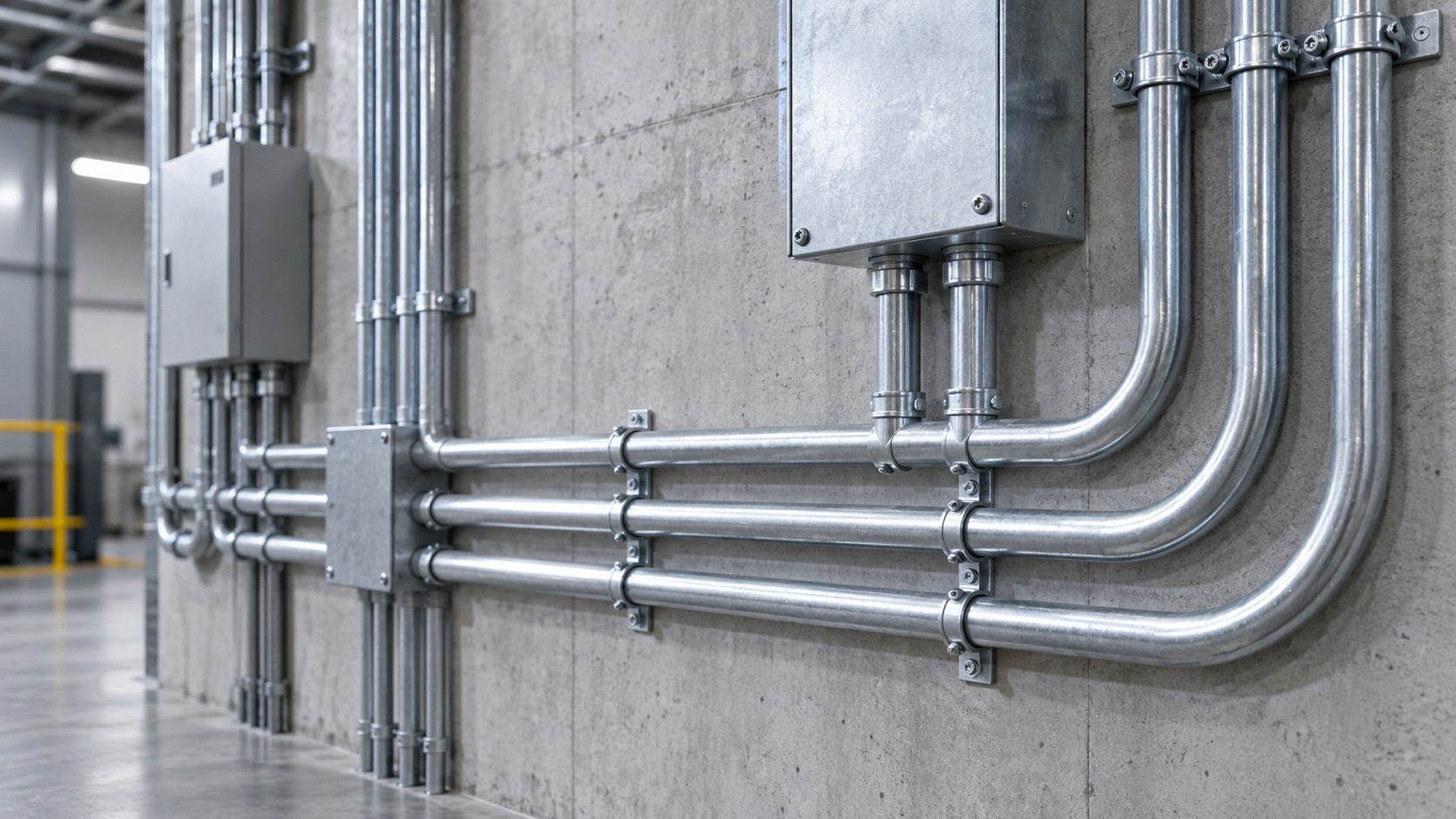
Fire compartmentation fails at the penetrations, not in the middle of the wall. Where a cable tray crosses a fire-rated wall or floor slab, the opening must be sealed with a system that has been tested for that exact combination of tray, cables and construction, and where the cables must keep working during a fire, the tray itself has to survive the test temperature. Steel does; aluminium generally does not.
What a firestop actually has to do
A firestop restores the fire resistance of a building element that has been penetrated. Under the European system, penetration seals are tested to EN 1366-3 and linear joint seals to EN 1366-4, then classified to EN 13501-2 using the letters E (integrity) and EI (integrity plus thermal insulation) followed by the duration in minutes, for example EI 60 or EI 120. In North America, through-penetration firestops are tested to UL 1479 / ASTM E814, which produces an F rating (flame passage) and a T rating — the T rating being the time until the temperature on the unexposed side rises by 325 °F (181 °C) above ambient.
The essential point for cable tray work is that a firestop is tested as a system: wall type, tray type, cable type, fill ratio and sealing product all appear in the test report. Substituting any one of them without documented approval voids the basis of the classification.
Fire survival of the tray itself
Firestopping the opening is only half the problem. If the cables on the tray are required to keep operating during a fire — for smoke extraction, fire pumps, emergency lighting or firefighting lifts — the cable support must hold them in place for the whole required duration.
This is where material choice becomes a matter of physics rather than preference. Circuit integrity cables are tested at temperatures of roughly 830 °C and above under IEC 60331-1 (fire with shock, up to 0.6/1 kV), IEC 60331-2 (above 0.6/1 kV) or EN 50200 (fire alone with mechanical shock, giving PH30, PH60, PH90 or PH120 classifications). BS 8519, which covers the selection and installation of fire-resistant power and control cable systems for life safety and firefighting applications, requires that the supports maintain circuit integrity for the same duration as the cables.
| Tray or support material | Behaviour in a fire | Suitability as a fire-rated cable support |
|---|---|---|
| Carbon steel, hot-dip galvanised | Melting point roughly 1 500 °C; loses mechanical strength progressively above about 500 °C but does not melt at typical circuit-integrity test temperatures | Commonly used; confirm the tested configuration and, where required, fire protection of the support |
| Stainless steel | Melting point roughly 1 400-1 500 °C, retains strength better than carbon steel at elevated temperature | Used where both corrosion resistance and fire performance are required |
| Aluminium alloy | Melting point roughly 660 °C, below the 830 °C circuit-integrity test temperature | Not suitable as a fire-rated support unless additional tested fire protection is applied |
| FRP / GRP (glass-reinforced plastic) | Organic resin matrix decomposes well below metal melting points; flame-retardant grades resist ignition but do not retain load-bearing capacity through a fire | Not used to support circuit-integrity cables unless part of a tested protected system |
IEC 61537, the product standard for cable tray and cable ladder systems, covers mechanical and electrical performance; it is not a fire-resistance standard. Fire performance comes from the tested combination of cable, support and penetration seal, not from the tray standard alone.
Cable performance classes you will see in specifications
Do not confuse “flame retardant” with “circuit integrity”:
- Flame propagation — IEC 60332-1 (single cable) and IEC 60332-3 (bunched cables, categories A, B, C, D).
- Circuit integrity — IEC 60331 series, EN 50200, BS 6387 (categories C, W and Z: flame at 950 °C for 3 h, water spray at 650 °C, and mechanical shock at 950 °C), and BS 8491 (fire, water and shock combined, typically 120 minutes).
- Smoke and acidity — IEC 61034 for smoke density and IEC 60754-1 / IEC 60754-2 for halogen content and gas acidity.
- European construction products route — EN 50575 with reaction-to-fire classes under EN 13501-6, from Aca and B1ca through B2ca, Cca, Dca and Eca to Fca.
Typical sealing methods
- Mineral wool with ablative or intumescent coating — the traditional method for larger openings; the coating thickness and the wool density are specified in the tested detail.
- Intumescent blocks or pillows — modular, removable for future cable additions, which suits data halls and plants with frequent change.
- Firestop collars and wrap strips — for non-metallic pipes and bundles; relevant where cable routes share a penetration with services.
- Fire-rated boards and pre-formed sleeves — useful where penetrations are repeated many times, because the detail is identical at every location.
- Sealants and gaskets — used to finish annular gaps; a sealant alone is rarely the whole tested system.
Whatever the method, the annular gap, the depth of the seal and the backing material must match the tested detail. A 25 mm gap sealed with a product tested at 10 mm is not the tested system.
Application Scenario: Cable Tray Crossing a Two-Hour Fire Compartment Wall
Scenario constraints
An industrial plant has a cable route carried on ladder tray that must cross a wall rated at two hours, carrying both normal power cables and a fire-critical circuit for smoke extraction fans. The tray is continuous through the opening, the penetration is shared with two spare ways for future cables, and the plant intends to add cables over the life of the installation.
Selection approach
Choose a penetration seal tested to EN 1366-3 and classified EI 120 to match the wall, with a test report that names ladder-type tray, the cable types and the maximum fill ratio. If the smoke extraction circuit must survive, specify circuit-integrity cables to IEC 60331 or EN 50200 with a duration matching the wall, and support them on steel tray or on a fire-protected support in accordance with BS 8519 rather than on aluminium. Reserve the future capacity with removable intumescent blocks so that adding a cable does not require breaking out and rebuilding the seal.
Common mistakes
- Substituting aluminium tray for steel after the fire strategy has been written, because aluminium melts below the circuit-integrity test temperature.
- Using a firestop product tested with small round cables on a large ladder tray with a different fill ratio.
- Sealing the opening but leaving the tray supports inside the compartment unprotected.
- Adding cables later without re-establishing the tested seal, leaving an unsealed gap.
- Assuming a flame-retardant cable (IEC 60332) will keep operating in a fire — it will not; that requires circuit-integrity testing (IEC 60331 or EN 50200).
Acceptance checkpoints
- Test or classification report references the exact wall or floor construction, tray type and cable types.
- Installed seal depth, backing material and annular gap match the tested detail.
- Circuit-integrity cables and their supports carry the required duration classification.
- Spare capacity is sealed, not left as an open hole.
- Photographic record and location tags for every penetration, cross-referenced to the product used.
- Installation carried out by personnel trained in the specific firestop system, with a signed register of penetrations.
Selection checklist
- Required fire resistance duration and whether E or EI is specified.
- Wall or floor construction, thickness and material.
- Tray type, width, and maximum cable fill ratio covered by the test.
- Cable types, diameters and whether circuit integrity is required.
- Future cable additions: choose a re-enterable system if the answer is yes.
- Environmental conditions: humidity, washdown, chemicals, UV — these affect both the tray material and the sealant.
- Local code: EN 1366-3 / EN 13501-2 in Europe, UL 1479 and NEC 300.21 in North America; NEC 300.22 and NEC 645 also apply where the route passes through air-handling or IT equipment spaces.
Quality inspection points
Inspect before closing: confirm the product labelling matches the approved detail, measure seal depth, check that cables are not bundled in a way the test did not cover, and confirm that any sleeves are mechanically secured. Where tray is used as part of the earthing or bonding arrangement, confirm that the firestop does not interrupt the electrical continuity required by the installation standard; IEC 61537 covers continuity for tray systems, and the bonding detail should be stated in the design.
How to evaluate a supplier
Ask for the classification report, not the product datasheet, and check whether the report covers your tray type. Ask how spare capacity is handled, whether the system is re-enterable, and who is trained to install it. A supplier who can name the test standard and the tested configuration is worth shortlisting. For tray options and materials, contact our team.
Frequently asked questions
1. Is a firestop tested for cables valid for a cable tray?
Only if the test report names the tray type and configuration. Cable penetrations and tray penetrations are different tested systems.
2. Can aluminium cable tray support fire-rated cables?
Aluminium melts at roughly 660 °C, below the 830 °C used in circuit-integrity testing, so it is not suitable without a tested fire protection measure.
3. What is the difference between EI 60 and EI 120?
Both are EN 13501-2 classifications: E is integrity and I is thermal insulation, with the number giving the duration in minutes — 60 or 120 minutes respectively.
4. What do the F and T ratings mean?
They come from UL 1479 / ASTM E814. F is flame passage time; T is the time until the temperature on the unexposed side rises by 325 °F (181 °C) above ambient.
5. Is a flame-retardant cable the same as a fire-resistant cable?
No. IEC 60332 covers flame propagation; circuit integrity during fire is covered by IEC 60331, EN 50200, BS 6387 or BS 8491.
6. Can I add cables to an existing firestop later?
Yes, if the system is designed as re-enterable and the additional configuration is covered by the test. Record every modification.
7. Does the firestop affect tray earthing?
It can. Confirm the bonding arrangement across the penetration and check that the design states how continuity is maintained.
Specifying a fire-rated cable route?
BANGE Electric supplies cable tray and cable ladder systems in steel, stainless steel and aluminium, and can discuss support selection for fire-rated routes. Contact our team with your wall or slab detail and required rating. Requirements may vary by application, market, and applicable standard.