
A panel board and a switchboard both distribute electrical power to downstream circuits and protect those circuits with overcurrent devices, but they differ in scale, construction, and where they sit in the distribution hierarchy. A panel board is a smaller, wall- or cabinet-mounted assembly feeding final circuits, typically rated up to 1200 A. A switchboard is a larger, floor-standing assembly fed directly from a transformer or main service, typically rated from 1200 A to 6000 A, and it feeds panel boards and large loads rather than individual branch circuits.
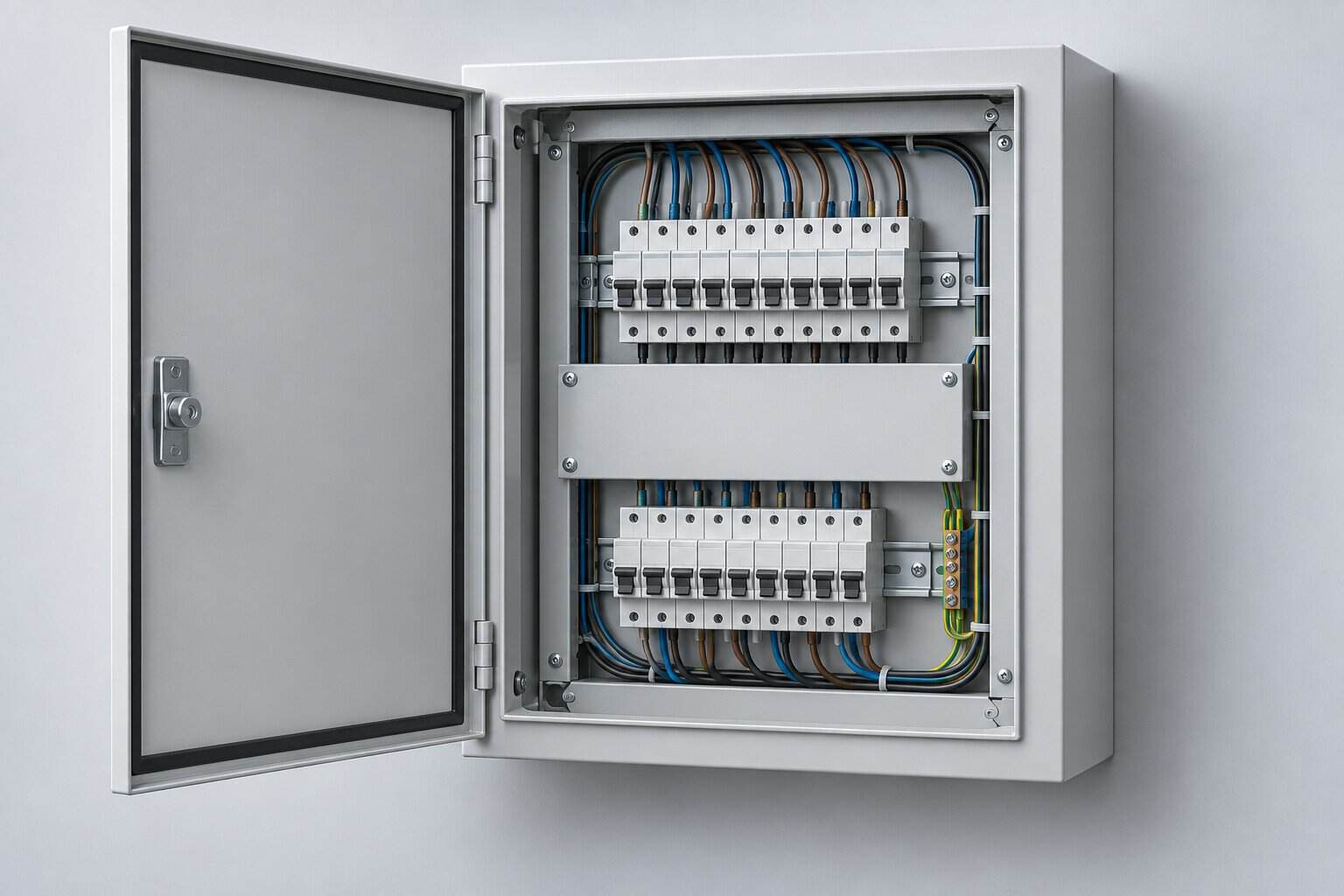
What Is a Panel Board?
A panel board — often called a distribution board or, in smaller form, a distribution box — is an assembly containing overcurrent protective devices (circuit breakers or fuses) that supply final branch circuits such as lighting, socket outlets, small machinery, and HVAC units. It is the last distribution point before the load.
Panel boards are fed by a single incoming source, usually from a switchboard or a transformer, and distribute through multiple outgoing ways. They are commonly wall-mounted or installed in a shallow floor-standing enclosure, with the breakers arranged in one or two vertical columns behind a hinged door with a trim.
Typical ratings are 100 A to 1200 A at voltages up to 1000 V AC. The applicable standard is IEC 61439-3 for distribution boards intended to be operated by ordinary persons, or IEC 61439-2 for power switchgear and controlgear assemblies; UL 67 applies in North America.
What Is a Switchboard?
A switchboard is a large, free-standing assembly of switching and protective devices — typically including a main incoming circuit breaker or disconnect, a main bus, metering, and multiple outgoing feeder breakers. It receives power directly from a transformer, generator, or utility service and distributes it to panel boards, motor control centers, and large individual loads.
Switchboards are front-access, dead-front assemblies, meaning all live parts are behind barriers and the operator works only from the front. In North America, UL 891 covers dead-front switchboards rated 600 V or less; IEC 61439-2 covers the international equivalent.
Typical ratings are 1200 A to 6000 A, with short-circuit withstand ratings commonly between 42 kA and 100 kA. Because they carry the full facility current, switchboards are built with much heavier bus bars and more robust bracing than panel boards.
Panel Board vs Switchboard: Key Differences
| Feature | Panel Board | Switchboard |
|---|---|---|
| Position in system | Final distribution — feeds branch circuits | Main distribution — feeds panel boards and large loads |
| Typical current rating | 100–1200 A | 1200–6000 A |
| Fed from | Switchboard, transformer, or sub-feed | Transformer, generator, or utility service |
| Mounting | Wall-mounted or shallow floor cabinet | Free-standing floor assembly, multiple sections |
| Access | Front, behind a single door | Front only (dead-front), multi-section |
| Bus construction | Smaller bus bars, often insulated | Heavy bus bars, braced for high fault current |
| Outgoing devices | MCBs and MCCBs, plug-on or bolt-on | MCCBs, ACBs, and insulated case breakers |
| Metering | Often none, or basic | Usually includes main metering and protection |
| Short-circuit rating | Typically 10–65 kA | Typically 42–100 kA |
| Applicable standard | IEC 61439-3 / UL 67 | IEC 61439-2 / UL 891 |
| Footprint | Under 1 m² typical | Several square metres, multi-section lineup |
Where Switchgear Fits In
The terminology gets confusing because “switchboard”, “switchgear”, and “panel board” are used inconsistently across regions. A useful way to separate them:
| Equipment | Primary role | Typical rating | Standard |
|---|---|---|---|
| Switchboard | Main low-voltage distribution, front access | 1200–6000 A | IEC 61439-2 / UL 891 |
| Switchgear | Switching and protection, often withdrawable | Up to 6300 A, LV or MV | IEC 61439-2 / IEC 62271-200 |
| Panel board | Final branch circuit distribution | 100–1200 A | IEC 61439-3 / UL 67 |
| Distribution box | Small final distribution, residential/commercial | Up to 250 A typical | IEC 61439-3 |
| Motor control center | Motor starters and protection | Up to 6300 A bus | IEC 61439-1 / UL 845 |
In practice, a large facility will have all of them: a switchboard or switchgear at the service entrance, feeding motor control centers and panelboards, which in turn feed distribution boxes and final circuits.
For guidance on the smaller end of this range, see our article on distribution box types and selection. For the protection end, see withdrawable vs fixed switchgear.
Internal Construction Compared
Panel Board Construction
- Enclosure — sheet steel cabinet with hinged door and removable trim, typically IP40–IP54.
- Phase bus — copper bars or insulated conductors rated for the board’s ampacity.
- Neutral and earth bars — separate terminal bars, often with multiple ways.
- Breaker mounting — plug-on (for MCBs onto a busbar comb) or bolt-on (for MCCBs).
- Wiring space — gutters along the sides for field cable routing.
Switchboard Construction
- Structure — multiple bolted sections forming a lineup, each with its own door.
- Main bus — heavy copper or aluminium bars, braced to withstand fault forces, often tin- or silver-plated.
- Incoming section — main ACB or MCCB with cable terminations sized for large conductors.
- Feeder sections — individual compartments for outgoing breakers.
- Barriers — form of internal separation (Form 1 to Form 4 per IEC 61439) isolating bus from devices from terminals.
- Instrumentation — metering, protection relays, and often communication to a building management system.
How to Choose Between Them
- Determine the total connected load and the demanded load with diversity applied. This sets the main current rating.
- Identify what you are feeding. Individual branch circuits point to a panel board; sub-feeders to other boards point to a switchboard.
- Calculate the available short-circuit current at the point of installation. This sets the required withstand rating — the single most commonly underspecified value.
- Decide the form of separation required. Critical facilities often require Form 3 or Form 4 so maintenance can be done on one section while others stay live.
- Check space and access. Switchboards need dedicated electrical room floor space, front clearance for operation, and often rear or side access for cabling.
- Plan for expansion. Switchboards are frequently specified with spare feeder ways and additional section space.
- Confirm the standard. IEC 61439 for most international projects; UL 67 and UL 891 for North America.
Application Examples
Panel Board Applications
- Floor-wise lighting and power distribution in commercial buildings
- Production area distribution in factories
- Hotel guest room floors and office zones
- Small workshops and retail units
- Final distribution inside larger plants, fed from a switchboard
Switchboard Applications
- Main low-voltage distribution in hospitals and data centers
- Service entrance distribution in industrial plants
- Transformer secondary distribution in utility substations
- Large commercial towers and mixed-use developments
- Any facility where the main incoming current exceeds about 1200 A
Safety Considerations
- Arc flash labelling. Both assemblies require an incident energy assessment and labelling per NFPA 70E or equivalent, and the label must reflect the actual available fault current.
- Restricted access. Switchboards should be in a locked electrical room accessible only to qualified personnel.
- Forms of separation. Higher separation forms reduce the risk of contact with live parts during maintenance and reduce arc propagation between sections.
- Proper clearances. Maintain the working clearance required by code in front of the equipment — this is routinely violated and is a real hazard.
- Selective coordination. Breakers must be coordinated so a downstream fault trips only the nearest device, not the main.
How to Inspect Quality Before Delivery
- Verify the assembly carries a valid type-test certificate for the applicable standard (IEC 61439-2 or UL 891).
- Check the nameplate: rated current, rated voltage, short-circuit withstand, form of separation, IP rating.
- Confirm bus bar sizing and plating against the approved drawing.
- Perform insulation resistance testing phase-to-phase and phase-to-earth.
- Confirm protective earth continuity across all sections and doors.
- Functionally test every breaker: open, close, trip, and any shunt or auxiliary contacts.
- Verify the form of separation visually — barriers must actually be in place, not just drawn.
Frequently Asked Questions
1. Can a panel board be used instead of a switchboard?
Only if the current and fault levels are within the panel board’s rating. Above about 1200 A, or where short-circuit current exceeds the panel board’s withstand rating, a switchboard is required.
2. Is a switchboard the same as switchgear?
Not exactly, though the terms overlap. Switchgear typically implies withdrawable or draw-out breakers and higher fault ratings, while a switchboard is usually fixed-mounted, front-access, low-voltage distribution. The distinction varies by region.
3. What is a form of separation?
IEC 61439 defines Forms 1 to 4, describing how much internal separation exists between bus bars, functional units, and terminals. Higher forms improve safety and maintainability at higher cost.
4. How do I determine the required short-circuit rating?
Perform a fault calculation for the point of installation, considering transformer impedance, cable impedance, and source contribution. The assembly’s rating must exceed the calculated prospective fault current.
5. Do I need both in one building?
In medium and large buildings, usually yes — a switchboard at the service or transformer, with panel boards on each floor or zone fed from it.
6. What maintenance do they need?
Periodic thermographic scanning for hot spots, torque checks on bus joints, insulation resistance testing, and functional testing of breakers. Intervals depend on the criticality and environment.
7. Can switchboards be extended later?
Yes, if space and spare bus capacity were provisioned at design stage. Adding a section to an existing lineup requires matching the original bus rating and form of separation.
Source Distribution Equipment from BANGE Electric
BANGE Electric supplies distribution boxes, panel boards, and low-voltage switchgear assemblies designed to IEC 61439, configured to your single-line diagram with the bus rating, form of separation, and short-circuit withstand your project requires.
Contact us with your load list, fault level, and applicable standard — we will respond within 24 hours with a technical proposal and quotation.
Requirements may vary by application, market, and applicable standard. Final specification should be confirmed with the engineering team.